

Dashboard Reports are provided to users of the Market Dashboard service. It is a collection of useful reports that allow subscribers to execute complex data queries directly against the Market Dashboard data warehouse. Using the Market Dashboard Query Express engine, users can view the data on-line or download the data in native Microsoft Excel.
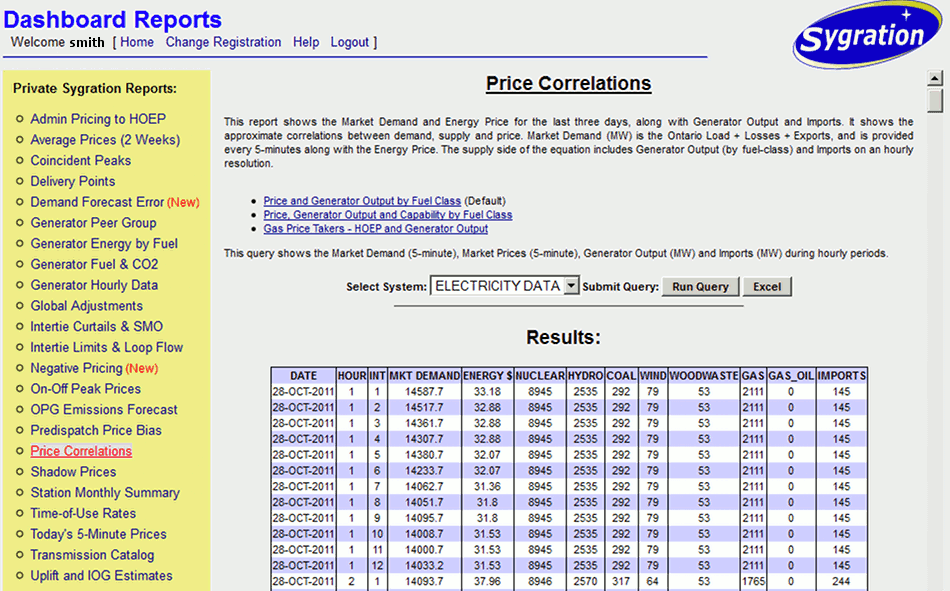
Reports are created based on suggestions and feedback of Market Dashboard customers. Your feedback and suggestions are encouraged by emailing Rodan Energy (info@rodanenergy.com). For a report to be considered, it must provide value-added benefits and be useful to other subscribers.
Admin Pricing to HOEP: The Report lists all hours having prices changed by the IESO Ex-Post desk within the last 180 days.
Average Prices (2 Weeks): This report shows the past two weeks of electricity prices including energy and operating reserve. There are three types of operating reserve reflecting how quickly the reserve must be provided if called upon: 10 minute spinning (currently, only generators can provide this), 10 minute non-spinning and 30 minute reserve.
Coincident Peaks: Coincident Peak Estimate Report for use by Transmission Demand Calculation and Global Adjustment 5-Coincident Peak Allocation. This series of reports are used to aid energy managers in determining the likelihood that a peak hour, or forecast peak hour, will remain the peak for the month (for TTDC Charges) or become one of the 5 top annual peaks in each Base Perdiod (for the Global Adjustment Allocation).
Delivery Points: This is a list of Delivery Points (generators, loads) whose locational pricing data is being collected in the Market Dashboard database. The Ontario electricity market sets a single market price for all Ontario resources, so these location price data reflect "shadow" prices to help identify transmission constraints within the system. There are currently about 320 Delivery Points.
Demand - Day Comparison: This report provides a Day-Over-Day comparison of Ontario Demand, comparing the current day's 5-minute actual Ontario Demand against the same interval for the previous day.
Generator Energy by Fuel: This report shows the monthly energy produced by all Ontario generators and Gross Imports, categorized by their fuel type. Data does not include output from smaller generators (less than 20MW) or generators embedded within local distributors as they are not reported by the IESO.
Generator Fuel & CO2: This set of reports query the Market Dashboard Generator Tracking database, which monitors generator output and models the fuel consumption and CO2 production of each fossil fuel station. The report continues to be in development and parameters are updated from time to time based on input from interested parties.
Generator Gas Hourly Output: This report shows the Hourly Market Price and the Output of the gas-fueled generators in Ontario for the past 14 days. These units are generally believed to be the marginal units within Ontario, and will thus tend to set the market price, or will have output that is reflective of it. Temperature is also provide from Environment Canada, delayed one day, using the hourly measurement at Toronto Pearson Airport in Degrees Celsius.
Generator Hourly Data: This report allows you to select a Generator Name and a Month, and the report will produce the hourly output and capability data (MWh) for that generator-month. Step 1.
Generator Peer Group: This report compares the average rate of return ($/MWh) of each Generator of the same fuel group (Nuclear, Coal, Hydro, Gas, Wind) for a selected month. It ranks the generators by $/MWh, but also includes their total GWh, average Capability (% of MCR) and average Output (% of MCR) for the target month.
Global Adjustments (and OPG Revenue): A process runs hourly to track output of each OPG and NUG-contract resource, and applies it against regulated and non-regulated rate formulas to estimate OPG Rebates and Global Adjustments. This report shows the MWh for each generation class (Regulated Nuclear, Regulated Hydro, Non-Regulated Hydro, Non-Regulated Fossil, and NUG). It reports on the MWh and revenue adjustments (OPG Rebate or portion of Global Adjustment) with values updated hourly. A sub-report also shows the estimated spot and adjusted revenue from energy for OPG - weeks before it is officially reported.
Note: There is still much room for improvements on the Global Adjustment estimates, so please provide feedback on potential ideas to improve this. For example, calculations do not include adjustments to cover OPA initiatives such as RFP generator contracts and demand response projects.
HOEP Monthly Average: This report gives the un-weighted monthly average Hourly Ontario Energy Price (HOEP) in $/MWh for any target month. It also shows the average Natural Gas price based on the daily spot price at DAWN and provides several estimates for fuel costs based on various Heat Rates (12, 10 and 8 mmBTU/MWh) assuming that a natural gas plant was responsible for setting HOEP. Finally, a calculated Heat Rate is determined based on the monthly HOEP.
Intertie Curtails & SMO: This report is experimental and exploits a difference between the published Adequacy report (generated by the DSO in Predispatch timeframe) and the Intertie Schedule and Flow (ISF) report (likely generated by the Interchange Scheduler leading up to the dispatch hour). The ISF report includes Segregated Mode of Operations (SMO) transactions at Q4C (Chats Falls) and B31L (RH Saunders) which are not included in the Adequacy report as they are considered out of market transactions. Even with the SMO values accounted for, there remains differences between the two IESO reports which are likely the result of curtailed or failed intertie transactions. This report highlights those differences.
Intertie Limits & Loop Flow: This report lists the Real-Time and Predispatch Intertie Limits for each Ontario Intertie for the past 2 days up to the current day, or day ahead if a predispatch run exists for that day.
Negative Pricing: This report shows the hours when the energy price (HOEP) was below zero and loads were paid by generators to consume electricity. Negative Pricing can occur in hours where there is significant surplus baseload generation. It results in a credit to wholesale consumers for those hours, while generators must actually pay into the market for energy they produced.
Northwest Capability: This report provides an hourly picture of the Supply and Demand Capability of North-Western Ontario. This area has significant transmission constraints and often runs into period of over-supply with bottle-necked generation, or under-supply as tie-lines approach their maximum capabilities. Complicating the issue is the fact that industry in the area is very resource intensive and fluxuates greatly with economic drivers.
On-Off Peak Prices: This report is useful for traders of financial swaps. It shows the mix of current and forecast energy prices for each hour, categorized into On-Peak and Off-Peak times. On-peak is defined as Monday-Friday, 7AM - 10PM local Eastern Time. The prices adjusts automatically for HOEP when it is available, and uses the latest Predispatch prices otherwise.
Predispatch Price Bias: While HOEP is based on the average energy price during the hour, the Predispatch forecast price is based on the peak demand expected within the hour. As a result, the forecast price is often higher than the final HOEP. The IESO provides an estimate for this "Predispatch price bias" as part of their intertie transaction failure charge. This report tracks the actual average price bias for each hour, as well as the bias' standard deviation that can be used as a measure of the forecast quality.
Price Correlations: This report shows the Market Demand and Energy Price for the last three days, along with Generator Output and Imports. It shows the approximate correlations between demand, supply and price. Market Demand (MW) is the Ontario Load + Losses + Exports, and is provided every 5-minutes along with the Energy Price. The supply side of the equation includes Generator Output (by fuel-class) and Imports on an hourly resolution.
Shadow Prices: This report allows you to dump (HTML or Microsoft Excel) the past 2-weeks of shadow price data for one of over a hundred Delivery Points. It includes 5-minute prices for energy and each class of operating reserve.
SSR Search: The IESO issues a System Status Report (SSR) on a regular basis and updates it whenever there is a significant market or system event. This report is used to search the SSR historical database for text strings in the advisory or notes databases. All searches are limited to the past 5 years.
Station Monthly Summary: This report lists the history of all Generators in the Ontario market. You can select any generator to show Maximum Output (MW), Output Energy (MWh), Average Capability and Revenue Estimate (based on Output[h] X HOEP[h]) for all months starting from December 2003.
Time-of-Use Rates: Retail customers on Smart Meters in Ontario will soon be paying a regulated time-of-use rate. This report categorizes each spot market energy price (HOEP) into the appropriate OEB peak definition (On Peak, Mid-Peak or Off-Peak) and reports on the actual average spot market price for each category. This shows how close the regulated rates are to the actual spot-market rates for those hours.
Today's 5-Minute Prices: This query shows the 5 minute market clearing prices (MCP) for Ontario electricity; energy and the three classes of operating reserve. All times are in Eastern Standard Time (EST).
Transmission Catalog: This report is a catalog of Ontario Transmission Circuits and Images from the Market Dashboard database. Circuit names are automatically detected by the Market Dashboard Market Scraper when processing IESO SSR files.
Uplift and IOG Estimates: This report provides a 2-week history of the Ontario Uplift Estimate, and the component of the Uplift attributed by the Intertie Offer Guarantee.
Wind Forecast and Actual: Report shows the hourly IESO Wind Forecast for the various zones within Ontario for the past 7 days, along with the actual output by the Wind generators in that zone